26.4.09

MUSICAL COUPLE MAKE HISTORY SING

Yo soy libre como el viento/ I am as free as the wind
Pero tengo dignidad/ but I have dignity
Adoro la libertad/ I adore freedom
Con todo mi corazón/ with all my heart
- from the 19th century song, La China Mexicana

In songs about patriotic señoritas and murdered revolutionary heroes, Consuelo Martinez and Lorenzo López make Mexico's history come alive. For many years the duo called Arena de Río has researched and performed traditional songs from Mexico's early 19th-century struggle for independence through the Revolution a hundred years later. What started as a passion for Mexico's old music has become a mission to help listeners restore their eroded links to the past.

Consuelo: "It's sad." Lorenzo: "We've forgotten our roots." The two are more than a musical duo; they're husband and wife. In conversation, one often completes the other's thoughts.

"With all the telenovelas, pop stars and soccer," Lorenzo continues, "sadly, people don't know their history, they don't know their music, don't know the old customs."

The duo's name, arena de río, means "river sand." They say there is pride in seeing themselves as "a grain of sand" in efforts to enrich Mexican culture.

Ironically, the search to recover Mexico's past was reinforced in Berkeley, California. While spending time at the university, Lorenzo and Consuelo discovered a gold mine of Mexican history and music. That started them on an exhaustive research project. They have sifted through documents and sheet music in Mexican universities, libraries and archives. And they've sought out songs passed down from one generation to the next.

"We listened to the music of old people," Lorenzo says.

"For example," says Consuelo, "a woman in her 80s, who learned the songs of her grandmother" -- songs going back to before the 1910 revolution.

You can learn about Mexico from Arena de Río's music. Or, you can just sit back and let the music flow over you -- Consuelo's beautiful, deep voice, Lorenzo's lilting guitar, their sweet harmonies. There are many love longs among their CDs.

¿Que haré lejos de tí, prenda del alma?/ What will I do far from you, part of my soul?
¿Sin verte, sin oirte y sin hablarte?/ Without seeing you, without
hearing you and without talking to you?
¿Como quitar la esencia de las flores?/ How to give up the essence of flowers?
¿Como quitarle al viento la armonia?/ How to give up the wind's harmony?
¿Como negar que te amo, vida mia?/ How to deny that I love you, my life?
¿Como borrar de mi alma esta pasion?/ How to erase this passion from my soul?
- from the romantic song, Prenda del Alma

"Which came first, music or love?" I ask. They laugh. Music and love are intertwined, they say. Consuelo: "Gracias a la música (thanks to the music), we got to know each other."

Together, they have performed and searched out traditional music for 25 years, living most of that time in La Paz. Lorenzo, 50, was born in Mexico City; Consuelo, four years younger, came from Guadalajara. They have two daughters, ages 18 and 10.

Their latest project combines music and theatre. Vamos a Cantar la Historia (let's sing the history) is a stage production that involves school children in a reenactment of events from the struggle for independence through the French intervention and the Mexican Revolution. Vamos a Cantar la Historia is also the title of a CD of spoken word and songs, a studio recording of their project.

This coming year will be busy for Lorenzo and Consuelo with the approach of the 2010 celebrations of both the 200th anniversary of Mexico's Independence and the 100th anniversary of the Revolution.

As they talk about the project and the history behind it, their faces light up. They explain that this latest CD is a distillation of so much research. The details, too many to include, have caused the historic personalities to come alive for them. "These heroes were people," Consuelo says. "They made mistakes, but they had convictions to improve life."

Y de orgullo el alma llena/ And with my soul filled with pride
Declaro de buena gana/ I gladly declare
Que soy pura mexicana/ That I am all Mexican
Nada tengo de español/ I have nothing of the Spanish in me
- La China Mexicana

You can hear samples of Arena de Río's music and learn more about the duo at their website at http://www.arenaderio.com/ and a second website at www.myspace.com/arenaderio. They have four CDs: Vamos a Cantar la Historia, Reflejos de Ayer (reflections of yesterday), Una Mañanita Azul (a blue morning) and Voy Llegando a mi Pueblito (I'm on my way to my village). You can purchase CDs directly from the artists. E-mail arenaderio@yahoo.com

22.4.09

LA PAZ: LOOKIN' GOOD AT AGE 474

The City of La Paz marks the 474th anniversary of its founding in May. This historic event was a long time coming. It actually took the Europeans five tries to found the settlement that became La Paz. Here's how it happened, as recounted in the city's celebration brochure.

The first Spaniard to arrive was Fortún Jiménez de Bertandoña, mutineer pilot of "La Concepción." He came in 1533, but he and his 22 sailors were killed by the native Guaycuras.

Two years later, on May 3, 1535, Hernán Cortés arrived and named the bay and harbor Santa Cruz. That day has become the official date of the founding anniversary. However, Cortés failed to establish a permanent colony. Sixty-one years later (in 1596), Sebastián Vizcaíno disembarked and named the port La Paz. But he didn't create a settlement, either.

There were two more attempts: one in 1683 by the admiral Isidro de Atondo y Antillón; another in 1720 by Jesuits Juan de Ugarte and Jaime Bravo, who established the mission of "Nuestra Señora del Pilar de La Paz." They abandoned the mission 15 years later.

It wasn't until 1811 that Governor Felipe de Goicoechea gave the area to Juan José Espinoza to start a settlement. That was the beginning of the permanent colony of La Paz.

27.3.09

SONG FROM HER HEART

My heart opens itself to your voice
Like the flowers open to the kisses of the dawn!

When soprano Loyda Vázquez sang these words from the French opera Samson et Dalila on stage in La Paz earlier this month, she was singing from her heart.

That's partly because she had been preparing for the concert for a year. And because she is passionate about bringing opera to life through voice and theatre. But what made the event especially heartfelt was that the pianist was her father, David Vázquez Cosío. He now lives in Mexico City. Because of this, father and daughter perform concerts together only once or twice a year.

"I don't even have to look at him for us to understand one another," Loyda tells me. She pauses to reflect for a moment, placing her hand on her heart. "He says, 'Your heart and mine are the same.' And so, it is a very special experience."

Loyda Vázquez Lizárraga has been playing music with her father since she was six years old. Now she's 38. Her dad is 73.

In Guadalajara, where Loyda grew up, there were always musicians in the family home. Singers, violinists, cellists and others came to play with her father. A concert pianist and professor of music at the University of Guadalajara, David Vázquez started by teaching his young daughter piano. But Loyda had other plans. "Being a pianist was not for me." Asked why, Loyda is emphatic: "¡No soy yo, No soy yo! " — she does not feel truly herself at the keyboard.

Even at the age of six, Loyda knew she wanted to be a singer. "When I sing, I feel as if I am flying." She stretches out her arms like a paloma and laughs. The laughter is musical. Her sentences have the cadence of a song. But the effect is not theatrical. Loyda's manner is natural. She simmers with warmth.

Loyda was 10 when she began voice lessons with her father. Singing is her passion: "I believe that when you sing, your soul is exposed." Perhaps that is why, for her, performances are not without angst.

"Always, I'm nervous before going on stage," she says. "But then, once I am on stage, I feel fine. For me, it's a privilege to sing. My voice is a gift, something to share."

Loyda came to La Paz on a family holiday and fell in love with the city — the Malecón, the beach, the tranquility. She moved here almost five years ago with her husband Gustavo and their son, who is now 11. In addition to performing, she teaches voice and choral work at the state music school.

Loyda's favourite language for singing is Italian, followed by German — she says that's because the words flow so freely. She enjoys singing in French, too: "It's very delicate." But what about her native language? "I don't like to sing in Spanish," she says, because some consonants are hard to sing in a way that's easily understood. "The diction is very difficult."

She is a performer who feels passionately that the voice reveals the person within. "I believe that when you sing, your soul is exposed," she says. "When I sing, I say, 'This is who I am. Listen to me. This is who I am.' "

On May 30 in La Paz, Loyda Vázquez and a second soprano will perform a series of duets and solos from Stabat Mater Dolorosa ("The sorrowful mother stood").

1.3.09

Genoveva Pérez León; photo below is Eulalia León Talamantes

MAKERS OF THE STORM DOLLS
Walk into the La Paz home of Genoveva Pérez León and you enter a kaleidoscope: hot-pink ribbons, a rainbow of cloth swatches piled high, shelf after shelf of jars filled with beads and shells and sequins. And everywhere there are dolls — brilliantly costumed cloth dolls.

Genoveva is a maker of muñecas. It is an art learned from her grandmother and mother on the family ranch near Todos Santos during a hurricane season 60 years ago.

"I was the oldest of 10 children. I didn't have time to make dolls because I would be doing the chores," she tells me. But when the storms hit, everyone had to hunker down indoors. While the children waited for a break in the weather, they started making dolls to pass the time. "We called them chubasqueras (storm dolls)."

Genoveva lifts one doll after another from a large glassed-in cabinet and stands them on the table. She introduces each: This one with the braids is La Serena, from the ranch land of her own Sudcaliforniana hills. This one in the ruffled orange dress is La Costa, from the coast. And this beauty in elegant red satin, sequins and embroidered flowers is Florida Pitahaya.

Genoveva is 67. I am 60. But we could be girls again, playing with dolls.

I pick up La Serena and stroke the ranchera doll's thick yarn braids, tied with pink bows. Her lips are embroidered cherry-red. I lift the ruffled flower skirt and admire the white lace petticoat, knickers and black velvety slippers.

It takes Genoveva three days to make one doll. In her work, nothing goes to waste. "I do not like to throw out cloth," she says. From small scraps, she makes dolls the size of a baby finger, each snug inside a bottle capped with a seashell.

Later, Genoveva takes me to meet her mother, Eulalia León Talamantes. Eulalia, who lives with another daughter a short drive away, has just celebrated her 91st birthday. She has lost sight in one eye, but has no problem threading a needle. And she is still making dolls.

Yes, Eulalia says, it is a little sad to say Adios to a doll when it comes time to sell it. "But then, I can make another. I love making dolls." Her daughters estimate that their mother has made more than a thousand of them.

Eulalia is matriarch of five generations living nearby: there are 10 children, 41 grandchildren, 58 great grandchildren and 10 great-great grandchildren. The family hopes that someone among the youngsters will continue the tradition of making dolls.

But Genoveva isn't taking any chances. As part of a government project a few years ago, she taught a course in doll-making to eight women in the ranch country where she grew up. She says five of the women are continuing the work.

I ask Genoveva if there is anything else she would like to say. "Tell people, if anyone wants to learn, I would be happy to teach them, so that this art isn't lost. I love making dolls."

Where to purchase the storm dolls: You can order by phone at 612-122-6349 or look for the dolls on sale Saturdays near the kiosko on the Malecón (at the foot of 16 de Septiembre). You can also find the dolls at Allende Books, Independencia 518, between Serdan and Prieto.

31.12.08

GALLERIES GALORE IN LA PAZ
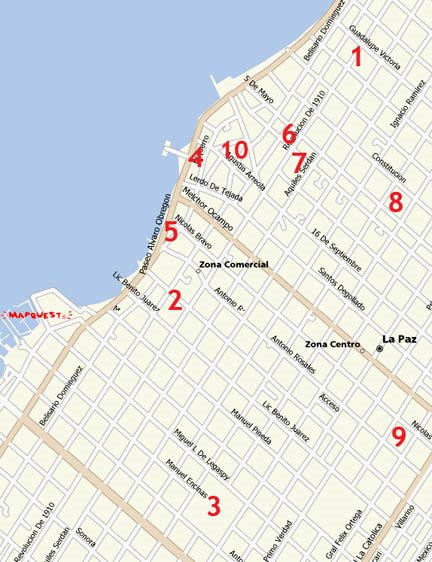
Art galleries are springing up in La Paz like cactus flowers after the rains. In the past year alone, five new galleries have opened, all in easy walk from one another. In addition, there are treasures on the walls of a new restaurant, a bookstore and a coffeeshop. I’ve drawn a map that will lead you on a self-guided tour of 10 venues for art browsing. Each red dot on the map below is numbered, matched up to the key below the map. Most galleries closed for a holiday break; they should be open again by Jan. 5. Your first stop could be the tourist information centre on the corner of 16 de Septiembre and Belizario Dominguez. It’s a few steps away from our first stop on the gallery circuit. There you can pick up a city map and learn more about La Paz.


1. Teatro Juárez
This historic building opened as a community theatre almost 100 years ago. It’s now a centre for music, dance and theatre, as well as exhibitions of art. A group of citizens has undertaken a major restoration project, financed by people who support the theatre. There’s generally a new exhibit every month. Location: Belizario Dominguez between 16 de Septiembre and Independencia. Hours: 9 a.m. to 1:30 p.m. and 5 to 7 p.m. Monday through Friday.

2. Galería Gato Negro
La Paz artists Lila Magallón and Nora White opened this gallery in 2008. Last month they launched a major show, continuing this month, of 10 contemporary La Paz painters and sculptors. The gallery is next to Teatro Juárez on Belizario Domingez 1435, between 16 de Septiembre and Independencia. An artist is on hand 10 am to 2 pm Monday through Saturday, but you can visit the gallery whenever the adjoining restaurant is open (8 a.m. to 11 p.m.). For more information, e-mail galeriagatonegro@gmail.com

3. Loto Cafebrería
This little gem of an enterprise is a coffeeshop, gallery, art workshop, gift and book-and-magazine store rolled into one. Loto recently celebrated its first anniversary. It’s on Independencia 415 (between Revolución and Serdán across the street from the cathedral). Phone number is 122-5054. There is generally a new exhibit every month. Hours: 8 a.m. to 10 p.m. Monday through Friday and Saturday 9 a.m. to 10 p.m.

4. Allende Books
This is mainly an English-language bookstore, but you will find lots of art on the shelves and walls at Independencia #518, between Serdan and G. Prieto. Some of what you’ll see: engravings by La Paz artist Rojo, jewelry by La Reyna Sofia, paintings by San Miguel de Allende artist Carmelo Gutierrez, and retablos (bookstore owner Diane describes these as “thank-you notes to Jesus”) by indigenous artists. Winter hours are 10 a.m. to 7 p.m. Monday through Friday and Saturday 10 a.m. to 2 p.m. Phone number is (612)125 9114.

5. Baja Six Art Group Gallery
Check back sometime in the future for this one. Classes continue, but the gallery is dormant. There are no regular hours posted. The building is next door to the art supplies store Papeleria Agruel, Guillermo Prieto #189 (between Reforma and Independencia).

6. Galerías Pax
This bright and shiny gallery is also a gift store and coffeeshop. It opened in December with an exhibit of recent work by La Reyna Sofia. In January, you can see paintings by San Luis Potosi artist Martha Harris. Gallery head Susana Alexander y Santin, who has moved here from Tijuana, also features the work of several high-quality artisanos from mainland Mexico. Location: Guillermo Prieto #1250 (between Cinco de Mayo and Constitución). Phone number is 121-6853. Hours 8 a.m. to 8 p.m. Monday through Friday; also open Saturday.

7. Galería de Arte Tonantzin
The gallery owners were once lawyers in Mexico City, but they developed a passion for art. Last year they moved to La Paz, which, says Moíses, enchanted them immediately. Tonantzin (the name has connections to both the Aztec goddess and the Virgin Mary) is not just an art gallery, but a cultural space for live performances. You'll find prehistoric pieces and contemporary Sudcalifornian and Latin American artists. There are concerts of live music in the gallery courtyard some evenings. Location: Constitución 320 (between Aquiles Serdán and Revolución), the same block as the post office. Phone number: 044-612-154-8136. Hours: 10 a.m. to 2 p.m. and 5 to 8:30 p.m. Monday to Saturday.

8. Las Tres Vírgenes
It’s actually a restaurant, but this stately old mansion-turned-restaurant is also the showcase for paintings of La Paz artist Ken Bonner, whose work is inspired by the beauty and colours of the Baja. You can see Bonner’s paintings whenever the restaurant is open, 5 to about 11 p.m., Tuesday through Sunday (the restaurant is closed Mondays). Las Tres Vírgenes reopened in December at this new location, 1130 Madero (between Constitución and Hidalgo), in the same block but across the street from its old location. For more information, contact the artist at painting_ken@hotmail.com or contact the restaurant (telephone 123-2226 or email lastresvirgenes@email.com ).

9. Ches & Gabo
The gallery features artists Alejandra Morente, Alfredo Mendoza and the well-known Baja painter Gabo. For now, viewing is by appointment only. I’m told that the gallery will soon establish regular hours and that there will also be shows of works by visiting artists. You can check to see if hours are posted on the door as you pass by the gallery on Belizario Dominguez 274 (between Cinco de Mayo and Constitución), Meanwhile, for information you can phone Alfredo on his cell phone: 044-612-157-8244.

10. Galería La Paz
Sidne Byars, an artist, collector and real-estate agent, established her first art gallery in La Paz 13 years ago. She features contemporary Mexican artists such as Gabo and Miguel Ramirez. You will also find original pieces that are functional – a clock, a lazy susan, a piece of furniture. The gallery is on the Malecón on Alvaro Obregón 299 and Constitución. Galería La Paz, which doubles as a real estate office, is open from 10 a.m. to 6 p.m. A second gallery is on Independencia, between Belizario Dominguez and Obregón. For more information, contact Sidne Byars sidne@galeria-la-paz.com

OFF THE MAP
They’re outside this map’s boundaries, but don’t forget these two major venues for art exhibitions in La Paz.
Alianza Francesa: There’s always a new exhibit at the French cultural centre. Admission is free. Centro Cultural Roger de Conynk is on Revolución 635 between Moreles and Guadalupe Victoria. It’s open Monday through Friday 10 a.m. to 1 p.m. and 5 to 7 p.m, and on Saturday 9 a.m. to 2 p.m. It’s the site of films, live performances of music, roundtable discussions and other special events.
Galería de Arte Carlos Olachea: Exhibits change monthly at this major gallery, which is next to Teatro de la Ciudad at Unidad Cultural, Navarro and Héroes de Independencia. Admission is free. Hours are Monday through Friday, 8 a.m. to 6 p.m. and weekends 9 a.m. to 6 p.m. Also check out the vestibule of Teatro de la Ciudad for other changing exhibits.

30.11.08

ALL THOSE WOMEN IN LA REYNA'S LIFE

La Reyna Sofia surrounds herself with an entourage of unexpected women. Among them you will find women wrestlers and boxers, virgins and prostitutes. They exist as tiny figures encased in glass, framed in metal, portraits hung from chains and beads. Sofia’s women are miniature works of art. And they have been her obsession these past five years.

“Why women?” I ask.

“I love everything about my women,” says Reyna Sofia Canales Orguayo. “I believe that when I paint a woman – her clothes, her boots, all of the details – I can make her come alive.” Indeed, you can appreciate the attention to detail when you turn over a pendant or earring: each of her women has a back, as well as a front.

Sofia works in pastels, water colours, tempura and ink. The women in her paintings and jewelry are bathed in a rainbow of colour.

“Lots of colours – to create a sense of happiness,” she says.

The 30-year-old artist and her husband Luis Carlos Rojo came to La Paz from Mazatlán a year ago. Luis Carlos is also an artist, an engraver. They have a two-year-old son.

Sofia smiles when I ask about her calling card and the signature on her work: “La Reyna Sofia.” She says her birth name – which means queen – is perfect for what she does. She needs no other title for her work.

Sofia is part of a blossoming art scene in La Paz. Like many other artists and artisans, she sells her work in sidewalk exhibits and new galleries in the centre of the city. If you are looking for hand-crafted gifts this December, here is a starter list of spots to browse, including the places where you will find work by Sofia and her husband.

Allende Books of La Paz: Independencia 518, between Serdan and G. Prieto, (612)125 9114. This English-language bookstore also sells some hand-crafted items, including Sofia’s necklaces.

Callejón Cultural: Artists and artisans are exhibiting and selling their work Saturdays 10 a.m. to 6 p.m. in December in the pedestrian lane called 21 de Agosto (next to Dorian’s between 16 de Septiembre and Arreola). The event is sponsored by the city of La Paz. You will find work by Sofia and her husband here.

Casa del Artesano Sudcaliforniano: Exhibit and sale of regional arts and crafts in wood, shell, clay, weaving, cultured pearls and more. Open daily 10 a.m. to 10.p.m., Malecón and Bravo next to the skateboard park. Information: 128-8707.

Galería Pax: Guillermo Prieto 1250 (between 5 de Mayo and Consitución), 121-6853. This is a new gallery, gift shop and cafe. An exhibit of Sofia’s work opens here Dec. 12.

Malecón: the area of the kiosk at the foot of 16 de Septiembre is the site of many events where you will find artisans selling their work. For example, the Sudcaliforniano folkloric festival, Dec. 13, features crafts as well as music, dance, stories, poetry and traditional foods, starting at 8 p.m.
Where else: If I've missed a spot you think should be in this list, please send me an e-mail with the information we need to find your suggested place to browse. rozinlapaz@yahoo.com