Roz in La Paz has a new website. Go to:
www.rozinlapaz.com
If you have trouble finding the site, please e-mail me at rozinlapaz@yahoo.com
Showing posts with label rozinlapaz. Show all posts
Showing posts with label rozinlapaz. Show all posts
16.9.09
CHILES STUFFED WITH HISTORY & DESIRE
The chiles not only looked good, they were indeed delicious – never before had Tita done such a marvelous job with them.
When you bite into a Chile en Nogada, you get a taste of Mexican history and legend. This is the dish that bewitched the wedding guests in Laura Esquivel’s novel, Like Water for Chocolate.
In the novel, the first wedding guest to react to the chiles in walnut sauce "immediately recognized the heat in her limbs, the tickling sensation in the center of her body, the naughty thoughts, and she decided to leave with her husband before things went too far. When she left, the party started to break up. " All the other chile-eating guests quickly made their excuses , throwing heated looks at each other, and left. Everyone was in a hurry to make mad passionate love.
The platters of chiles proudly wore the colors of the flag: the green of the chiles, the white of the nut sauce, the red of the pomegranates.
According to some historians, the dish that Esquivel cast as an aphrodisiac was, in fact, invented in the 1800s by nuns in the town of Puebla.
It was August 1821 and pomegranates were in season. The military commander Augustin de Iturbide had just signed the Treaty of Cordoba, granting Mexico its independence from Spain. He was travelling from Veracruz to Mexico City and planned to stop in Puebla, where there would be a feast in his honour. The Augustinian nuns of Santa Monica Convent created a special dish in the colours of the Mexican flag: green chiles, white walnut sauce and red pomegranates.
Nowadays, Chiles en Nogada are served in September, the month Mexicans celebrate Independence Day. It's not an easy dish to prepare, but if you're determined to try, google "chiles en nogada" and "recipes." Take your pick from the dozens of variations listed.
Or look for this dish on the menu at restaurants around town this month. One likely location is El Zarape, which specializes in traditional dishes. It's at 3450 México street (between Oaxaca and Nayarit).
The chiles disappeared in the blink of an eye. How long ago it seemed that Tita had felt like a chile in nut sauce left sitting on the platter out of etiquette, for not wanting to look greedy. Tita wondered whether the fact that there was not a single chile left on the platters was a sign that good manners had been forgotten or that the chiles were indeed splendid.
The chiles not only looked good, they were indeed delicious – never before had Tita done such a marvelous job with them.
Like Water for Chocolate, by Laura Esquivel
When you bite into a Chile en Nogada, you get a taste of Mexican history and legend. This is the dish that bewitched the wedding guests in Laura Esquivel’s novel, Like Water for Chocolate.
In the novel, the first wedding guest to react to the chiles in walnut
 sauce "immediately recognized the heat in her limbs, the tickling sensation in the center of her body, the naughty thoughts, and she decided to leave with her husband before things went too far. When she left, the party started to break up. " All the other chile-eating guests quickly made their excuses , throwing heated looks at each other, and left. Everyone was in a hurry to make mad passionate love.
The platters of chiles proudly wore the colors of the flag: the green of the chiles, the white of the nut sauce, the red of the pomegranates.
Like Water for Chocolate, by Laura Esquivel
According to some historians, the dish that Esquivel cast as an aphrodisiac was, in fact, invented in the 1800s by nuns in the town of Puebla.
It was August 1821 and pomegranates were in season. The military commander Augustin de Iturbide had just signed the Treaty of Cordoba, granting Mexico its independence from Spain. He was travelling from Veracruz to Mexico City and planned to stop in Puebla, where there would be a feast in his honour. The Augustinian nuns of Santa Monica Convent created a special dish in the colours of the Mexican flag: green chiles, white walnut sauce and red pomegranates.
Nowadays, Chiles en Nogada are served in September, the month Mexicans celebrate Independence Day. It's not an easy dish to prepare, but if you're determined to try, google "chiles en nogada" and "recipes." Take your pick from the dozens of variations listed.
Or look for this dish on the menu at restaurants around town this month. One likely location is El Zarape, which specializes in traditional dishes. It's at 3450 México street (between Oaxaca and Nayarit).
The chiles disappeared in the blink of an eye. How long ago it seemed that Tita had felt like a chile in nut sauce left sitting on the platter out of etiquette, for not wanting to look greedy. Tita wondered whether the fact that there was not a single chile left on the platters was a sign that good manners had been forgotten or that the chiles were indeed splendid.
Like Water for Chocolate, by Laura Esquivel


29.6.09
'Love can't always be trusted. You fight against it, but its power to hold you is too strong to resist.'
from on-line trailer of El Sortilegio
ROMANCE AND ART CAST A SPELL
ROMANCE AND ART CAST A SPELL
El Sortilegio is a soap opera with a bonus. The telenovela -- its English title is "Love Spell" -- uses Mexican art as a backdrop for each episode. That's because the show's producer, Carla Estrada, invited artists from across the country to send in samples of their work. From 900 submissions, well-known Mexican artist José Luis Cuevas helped choose 200 pieces. These have become part of the setting for this hot, new TV series, which began broadcast June 1.
If you have ever tuned in to a Latin American telenovela, you know that these soap operas offer a crash course in conversational Spanish. With Sortilegio, you also get the exposure to contemporary Mexican art, plus a plot thick with intrigue and romance.
Wikipedia describes the telenovela as a melodrama in miniseries format. These shows air in prime time -- five or six nights a week for about six months. They usually end with a bang. They are the most-watched genre of television program in the world, with at least two billion viewers worldwide.
The News, an excellent English-language newspaper in Mexico City, recently published an article on Sortilegio and the tie-in with Mexican art. Here's an excerpt from http://www.thenews.com.mx/
"Sortilegio treads some well-worn but entertaining soap-opera turf. Antonio Lombardo, a successful businessman, becomes alienated by his wife's inability to conceive and henceforth falls in love with and impregnates his best friend Samuel's wife Victoria, who gives birth to twins.
"Samuel goes on raising the children as if they were his own, while later, Antonio's wife dies during childbirth and gives birth to a baby boy. Later, Samuel dies and Antonio and Victoria are able to live life together, with three children completely in the dark as to the true nature of their relationship.”
The children grow to adulthood, and that's when the plot really thickens. A quote from Scottish writer Sir Walter Scott comes to mind: "Oh, what a tangled we weave, when first we practice to deceive."
For a five-minue introduction to Sortilegio, take a look at the English-language trailer on the Web. Go to http://www.dailymotion.com/relevance/search/Jacqueline-Bracamontes/video/x99zsl_sortilegio-trailer-english_shortfilms
The one-hour episodes, created by Televisa, air Monday through Friday at 9 p.m. on "canal de las estrellas" (channel of the stars) in most parts of Mexico. Check local time and channel for La Paz. Sortilegio has been in progress for a month, but with 95 episodes scheduled, there's time to catch up before the story reaches its dramatic conclusion in mid-October.
31.5.09
“La Vida Útil de Pillo Polilla” (the useful life of Pillo the moth) took to the stage at Teatro de La Ciudad June 19.
FROM PAPER MOTH TO BOOKWORM
Pillo Polilla is a paper-devouring moth who lives in a library, where he spends his days happily chewing through the bountiful collection of books. But then Pillo learns to read. And life for the moth turns upside-down.
Pillo finds magic in the world of literature -- everything from Twenty Million Leagues under the Sea to the poetry of Pablo Neruda. But his discovery causes him angst. What does a paper moth eat, if not books? He ventures out of the library on a quest to discover the meaning of his own existence.
The result is a prize-winning theatrical production, told through puppets and actors. La Vida Útil de Pillo Polilla (the useful life of Pillo the Moth) is an adaptation of the novel by Vivian Mansour Manzur, a writer whose witty plots and sense of humor have earned her two prestigious literary awards in Mexico. Lourdes Aguilera (pictured at right) adapted, produced and directed the stage production. The Association of Mexican theatre Critics judged the show to be “Best Children’s Work” in 2006.
FROM PAPER MOTH TO BOOKWORM
Pillo Polilla is a paper-devouring moth who lives in a library, where he spends his days happily chewing through the bountiful collection of books. But then Pillo learns to read. And life for the moth turns upside-down.
Pillo finds magic in the world of literature -- everything from Twenty Million Leagues under the Sea to the poetry of Pablo Neruda. But his discovery causes him angst. What does a paper moth eat, if not books? He ventures out of the library on a quest to discover the meaning of his own existence.

The result is a prize-winning theatrical production, told through puppets and actors. La Vida Útil de Pillo Polilla (the useful life of Pillo the Moth) is an adaptation of the novel by Vivian Mansour Manzur, a writer whose witty plots and sense of humor have earned her two prestigious literary awards in Mexico. Lourdes Aguilera (pictured at right) adapted, produced and directed the stage production. The Association of Mexican theatre Critics judged the show to be “Best Children’s Work” in 2006.
26.4.09
MUSICAL COUPLE MAKE HISTORY SING
Yo soy libre como el viento/ I am as free as the wind
Pero tengo dignidad/ but I have dignity
Adoro la libertad/ I adore freedom
Con todo mi corazón/ with all my heart
- from the 19th century song, La China Mexicana
In songs about patriotic señoritas and murdered revolutionary heroes, Consuelo Martinez and Lorenzo López make Mexico's history come alive. For many years the duo called Arena de Río has researched and performed traditional songs from Mexico's early 19th-century struggle for independence through the Revolution a hundred years later. What started as a passion for Mexico's old music has become a mission to help listeners restore their eroded links to the past.
Consuelo: "It's sad." Lorenzo: "We've forgotten our roots." The two are more than a musical duo; they're husband and wife. In conversation, one often completes the other's thoughts.
"With all the telenovelas, pop stars and soccer," Lorenzo continues, "sadly, people don't know their history, they don't know their music, don't know the old customs."
The duo's name, arena de río, means "river sand." They say there is pride in seeing themselves as "a grain of sand" in efforts to enrich Mexican culture.
Ironically, the search to recover Mexico's past was reinforced in Berkeley, California. While spending time at the university, Lorenzo and Consuelo discovered a gold mine of Mexican history and music. That started them on an exhaustive research project. They have sifted through documents and sheet music in Mexican universities, libraries and archives. And they've sought out songs passed down from one generation to the next.
"We listened to the music of old people," Lorenzo says.
"For example," says Consuelo, "a woman in her 80s, who learned the songs of her grandmother" -- songs going back to before the 1910 revolution.
You can learn about Mexico from Arena de Río's music. Or, you can just sit back and let the music flow over you -- Consuelo's beautiful, deep voice, Lorenzo's lilting guitar, their sweet harmonies. There are many love longs among their CDs.
¿Que haré lejos de tí, prenda del alma?/ What will I do far from you, part of my soul?
¿Sin verte, sin oirte y sin hablarte?/ Without seeing you, without
hearing you and without talking to you?
¿Como quitar la esencia de las flores?/ How to give up the essence of flowers?
¿Como quitarle al viento la armonia?/ How to give up the wind's harmony?
¿Como negar que te amo, vida mia?/ How to deny that I love you, my life?
¿Como borrar de mi alma esta pasion?/ How to erase this passion from my soul?
- from the romantic song, Prenda del Alma
"Which came first, music or love?" I ask. They laugh. Music and love are intertwined, they say. Consuelo: "Gracias a la música (thanks to the music), we got to know each other."
Together, they have performed and searched out traditional music for 25 years, living most of that time in La Paz. Lorenzo, 50, was born in Mexico City; Consuelo, four years younger, came from Guadalajara. They have two daughters, ages 18 and 10.
Their latest project combines music and theatre. Vamos a Cantar la Historia (let's sing the history) is a stage production that involves school children in a reenactment of events from the struggle for independence through the French intervention and the Mexican Revolution. Vamos a Cantar la Historia is also the title of a CD of spoken word and songs, a studio recording of their project.
This coming year will be busy for Lorenzo and Consuelo with the approach of the 2010 celebrations of both the 200th anniversary of Mexico's Independence and the 100th anniversary of the Revolution.
As they talk about the project and the history behind it, their faces light up. They explain that this latest CD is a distillation of so much research. The details, too many to include, have caused the historic personalities to come alive for them. "These heroes were people," Consuelo says. "They made mistakes, but they had convictions to improve life."
Y de orgullo el alma llena/ And with my soul filled with pride
Declaro de buena gana/ I gladly declare
Que soy pura mexicana/ That I am all Mexican
Nada tengo de español/ I have nothing of the Spanish in me
- La China Mexicana
You can hear samples of Arena de Río's music and learn more about the duo at their website at http://www.arenaderio.com/ and a second website at www.myspace.com/arenaderio. They have four CDs: Vamos a Cantar la Historia, Reflejos de Ayer (reflections of yesterday), Una Mañanita Azul (a blue morning) and Voy Llegando a mi Pueblito (I'm on my way to my village). You can purchase CDs directly from the artists. E-mail arenaderio@yahoo.com
Yo soy libre como el viento/ I am as free as the wind
Pero tengo dignidad/ but I have dignity
Adoro la libertad/ I adore freedom
Con todo mi corazón/ with all my heart
- from the 19th century song, La China Mexicana

In songs about patriotic señoritas and murdered revolutionary heroes, Consuelo Martinez and Lorenzo López make Mexico's history come alive. For many years the duo called Arena de Río has researched and performed traditional songs from Mexico's early 19th-century struggle for independence through the Revolution a hundred years later. What started as a passion for Mexico's old music has become a mission to help listeners restore their eroded links to the past.
Consuelo: "It's sad." Lorenzo: "We've forgotten our roots." The two are more than a musical duo; they're husband and wife. In conversation, one often completes the other's thoughts.
"With all the telenovelas, pop stars and soccer," Lorenzo continues, "sadly, people don't know their history, they don't know their music, don't know the old customs."
The duo's name, arena de río, means "river sand." They say there is pride in seeing themselves as "a grain of sand" in efforts to enrich Mexican culture.
Ironically, the search to recover Mexico's past was reinforced in Berkeley, California. While spending time at the university, Lorenzo and Consuelo discovered a gold mine of Mexican history and music. That started them on an exhaustive research project. They have sifted through documents and sheet music in Mexican universities, libraries and archives. And they've sought out songs passed down from one generation to the next.
"We listened to the music of old people," Lorenzo says.
"For example," says Consuelo, "a woman in her 80s, who learned the songs of her grandmother" -- songs going back to before the 1910 revolution.
You can learn about Mexico from Arena de Río's music. Or, you can just sit back and let the music flow over you -- Consuelo's beautiful, deep voice, Lorenzo's lilting guitar, their sweet harmonies. There are many love longs among their CDs.
¿Que haré lejos de tí, prenda del alma?/ What will I do far from you, part of my soul?
¿Sin verte, sin oirte y sin hablarte?/ Without seeing you, without
hearing you and without talking to you?
¿Como quitar la esencia de las flores?/ How to give up the essence of flowers?
¿Como quitarle al viento la armonia?/ How to give up the wind's harmony?
¿Como negar que te amo, vida mia?/ How to deny that I love you, my life?
¿Como borrar de mi alma esta pasion?/ How to erase this passion from my soul?
- from the romantic song, Prenda del Alma
"Which came first, music or love?" I ask. They laugh. Music and love are intertwined, they say. Consuelo: "Gracias a la música (thanks to the music), we got to know each other."
Together, they have performed and searched out traditional music for 25 years, living most of that time in La Paz. Lorenzo, 50, was born in Mexico City; Consuelo, four years younger, came from Guadalajara. They have two daughters, ages 18 and 10.
Their latest project combines music and theatre. Vamos a Cantar la Historia (let's sing the history) is a stage production that involves school children in a reenactment of events from the struggle for independence through the French intervention and the Mexican Revolution. Vamos a Cantar la Historia is also the title of a CD of spoken word and songs, a studio recording of their project.
This coming year will be busy for Lorenzo and Consuelo with the approach of the 2010 celebrations of both the 200th anniversary of Mexico's Independence and the 100th anniversary of the Revolution.
As they talk about the project and the history behind it, their faces light up. They explain that this latest CD is a distillation of so much research. The details, too many to include, have caused the historic personalities to come alive for them. "These heroes were people," Consuelo says. "They made mistakes, but they had convictions to improve life."
Y de orgullo el alma llena/ And with my soul filled with pride
Declaro de buena gana/ I gladly declare
Que soy pura mexicana/ That I am all Mexican
Nada tengo de español/ I have nothing of the Spanish in me
- La China Mexicana
You can hear samples of Arena de Río's music and learn more about the duo at their website at http://www.arenaderio.com/ and a second website at www.myspace.com/arenaderio. They have four CDs: Vamos a Cantar la Historia, Reflejos de Ayer (reflections of yesterday), Una Mañanita Azul (a blue morning) and Voy Llegando a mi Pueblito (I'm on my way to my village). You can purchase CDs directly from the artists. E-mail arenaderio@yahoo.com
22.4.09
LA PAZ: LOOKIN' GOOD AT AGE 474
The City of La Paz marks the 474th anniversary of its founding in May. This historic event was a long time coming. It actually took the Europeans five tries to found the settlement that became La Paz. Here's how it happened, as recounted in the city's celebration brochure.
The first Spaniard to arrive was Fortún Jiménez de Bertandoña, mutineer pilot of "La Concepción." He came in 1533, but he and his 22 sailors were killed by the native Guaycuras.
Two years later, on May 3, 1535, Hernán Cortés arrived and named the bay and harbor Santa Cruz. That day has become the official date of the founding anniversary. However, Cortés failed to establish a permanent colony. Sixty-one years later (in 1596), Sebastián Vizcaíno disembarked and named the port La Paz. But he didn't create a settlement, either.
There were two more attempts: one in 1683 by the admiral Isidro de Atondo y Antillón; another in 1720 by Jesuits Juan de Ugarte and Jaime Bravo, who established the mission of "Nuestra Señora del Pilar de La Paz." They abandoned the mission 15 years later.
It wasn't until 1811 that Governor Felipe de Goicoechea gave the area to Juan José Espinoza to start a settlement. That was the beginning of the permanent colony of La Paz.
The City of La Paz marks the 474th anniversary of its founding in May. This historic event was a long time coming. It actually took the Europeans five tries to found the settlement that became La Paz. Here's how it happened, as recounted in the city's celebration brochure.
The first Spaniard to arrive was Fortún Jiménez de Bertandoña, mutineer pilot of "La Concepción." He came in 1533, but he and his 22 sailors were killed by the native Guaycuras.
Two years later, on May 3, 1535, Hernán Cortés arrived and named the bay and harbor Santa Cruz. That day has become the official date of the founding anniversary. However, Cortés failed to establish a permanent colony. Sixty-one years later (in 1596), Sebastián Vizcaíno disembarked and named the port La Paz. But he didn't create a settlement, either.
There were two more attempts: one in 1683 by the admiral Isidro de Atondo y Antillón; another in 1720 by Jesuits Juan de Ugarte and Jaime Bravo, who established the mission of "Nuestra Señora del Pilar de La Paz." They abandoned the mission 15 years later.
It wasn't until 1811 that Governor Felipe de Goicoechea gave the area to Juan José Espinoza to start a settlement. That was the beginning of the permanent colony of La Paz.
27.3.09
SONG FROM HER HEART
My heart opens itself to your voice
Like the flowers open to the kisses of the dawn!
When soprano Loyda Vázquez sang these words from the French opera Samson et Dalila on stage in La Paz earlier this month, she was singing from her heart.
That's partly because she had been preparing for the concert for a year. And because she is passionate about bringing opera to life through voice and theatre. But what made the event especially heartfelt was that the pianist was her father, David Vázquez Cosío. He now lives in Mexico City. Because of this, father and daughter perform concerts together only once or twice a year.
"I don't even have to look at him for us to understand one another," Loyda tells me. She pauses to reflect for a moment, placing her hand on her heart. "He says, 'Your heart and mine are the same.' And so, it is a very special experience."
Loyda Vázquez Lizárraga has been playing music with her father since she was six years old. Now she's 38. Her dad is 73.
In Guadalajara, where Loyda grew up, there were always musicians in the family home. Singers, violinists, cellists and others came to play with her father. A concert pianist and professor of music at the University of Guadalajara, David Vázquez started by teaching his young daughter piano. But Loyda had other plans. "Being a pianist was not for me." Asked why, Loyda is emphatic: "¡No soy yo, No soy yo! " — she does not feel truly herself at the keyboard.
Even at the age of six, Loyda knew she wanted to be a singer. "When I sing, I feel as if I am flying." She stretches out her arms like a paloma and laughs. The laughter is musical. Her sentences have the cadence of a song. But the effect is not theatrical. Loyda's manner is natural. She simmers with warmth.
Loyda was 10 when she began voice lessons with her father. Singing is her passion: "I believe that when you sing, your soul is exposed." Perhaps that is why, for her, performances are not without angst.
"Always, I'm nervous before going on stage," she says. "But then, once I am on stage, I feel fine. For me, it's a privilege to sing. My voice is a gift, something to share."
Loyda came to La Paz on a family holiday and fell in love with the city — the Malecón, the beach, the tranquility. She moved here almost five years ago with her husband Gustavo and their son, who is now 11. In addition to performing, she teaches voice and choral work at the state music school.
Loyda's favourite language for singing is Italian, followed by German — she says that's because the words flow so freely. She enjoys singing in French, too: "It's very delicate." But what about her native language? "I don't like to sing in Spanish," she says, because some consonants are hard to sing in a way that's easily understood. "The diction is very difficult."
She is a performer who feels passionately that the voice reveals the person within. "I believe that when you sing, your soul is exposed," she says. "When I sing, I say, 'This is who I am. Listen to me. This is who I am.' "
On May 30 in La Paz, Loyda Vázquez and a second soprano will perform a series of duets and solos from Stabat Mater Dolorosa ("The sorrowful mother stood").
My heart opens itself to your voice
Like the flowers open to the kisses of the dawn!
When soprano Loyda Vázquez sang these words from the French opera Samson et Dalila on stage in La Paz earlier this month, she was singing from her heart.
That's partly because she had been preparing for the concert for a year. And because she is passionate about bringing opera to life through voice and theatre. But what made the event especially heartfelt was that the pianist was her father, David Vázquez Cosío. He now lives in Mexico City. Because of this, father and daughter perform concerts together only once or twice a year.
"I don't even have to look at him for us to understand one another," Loyda tells me. She pauses to reflect for a moment, placing her hand on her heart. "He says, 'Your heart and mine are the same.' And so, it is a very special experience."
Loyda Vázquez Lizárraga has been playing music with her father since she was six years old. Now she's 38. Her dad is 73.
In Guadalajara, where Loyda grew up, there were always musicians in the family home. Singers, violinists, cellists and others came to play with her father. A concert pianist and professor of music at the University of Guadalajara, David Vázquez started by teaching his young daughter piano. But Loyda had other plans. "Being a pianist was not for me." Asked why, Loyda is emphatic: "¡No soy yo, No soy yo! " — she does not feel truly herself at the keyboard.
Even at the age of six, Loyda knew she wanted to be a singer. "When I sing, I feel as if I am flying." She stretches out her arms like a paloma and laughs. The laughter is musical. Her sentences have the cadence of a song. But the effect is not theatrical. Loyda's manner is natural. She simmers with warmth.
Loyda was 10 when she began voice lessons with her father. Singing is her passion: "I believe that when you sing, your soul is exposed." Perhaps that is why, for her, performances are not without angst.
"Always, I'm nervous before going on stage," she says. "But then, once I am on stage, I feel fine. For me, it's a privilege to sing. My voice is a gift, something to share."
Loyda came to La Paz on a family holiday and fell in love with the city — the Malecón, the beach, the tranquility. She moved here almost five years ago with her husband Gustavo and their son, who is now 11. In addition to performing, she teaches voice and choral work at the state music school.
Loyda's favourite language for singing is Italian, followed by German — she says that's because the words flow so freely. She enjoys singing in French, too: "It's very delicate." But what about her native language? "I don't like to sing in Spanish," she says, because some consonants are hard to sing in a way that's easily understood. "The diction is very difficult."
She is a performer who feels passionately that the voice reveals the person within. "I believe that when you sing, your soul is exposed," she says. "When I sing, I say, 'This is who I am. Listen to me. This is who I am.' "
On May 30 in La Paz, Loyda Vázquez and a second soprano will perform a series of duets and solos from Stabat Mater Dolorosa ("The sorrowful mother stood").
1.3.09

Walk into the La Paz home of Genoveva Pérez León and you enter a kaleidoscope: hot-pink ribbons, a rainbow of cloth swatches piled high, shelf after shelf of jars filled with beads and shells and sequins. And everywhere there are dolls — brilliantly costumed cloth dolls.
Genoveva is a maker of muñecas. It is an art learned from her grandmother and mother on the family ranch near Todos Santos during a hurricane season 60 years ago.
"I was the oldest of 10 children. I didn't have time to make dolls because I would be doing the chores," she tells me. But when the storms hit, everyone had to hunker down indoors. While the children waited for a break in the weather, they started making dolls to pass the time. "We called them chubasqueras (storm dolls)."
Genoveva lifts one doll after another from a large glassed-in cabinet and stands them on the table. She introduces each: This one with the braids is La Serena, from the ranch land of her own Sudcaliforniana hills. This one in the ruffled orange dress is La Costa, from the coast. And this beauty in elegant red satin, sequins and embroidered flowers is Florida Pitahaya.
Genoveva is 67. I am 60. But we could be girls again, playing with dolls.
I pick up La Serena and stroke the ranchera doll's thick yarn braids, tied with pink bows. Her lips are embroidered cherry-red. I lift the ruffled flower skirt and admire the white lace petticoat, knickers and black velvety slippers.
It takes Genoveva three days to make one doll. In her work, nothing goes to waste. "I do not like to throw out cloth," she says. From small scraps, she makes dolls the size of a baby finger, each snug inside a bottle capped with a seashell.
Later, Genoveva takes me to meet her mother, Eulalia León Talamantes. Eulalia, who lives with another daughter a short drive away, has just celebrated her 91st birthday. She has lost sight in one eye, but has no problem threading a needle. And she is still making dolls.
 Yes, Eulalia says, it is a little sad to say Adios to a doll when it comes time to sell it. "But then, I can make another. I love making dolls." Her daughters estimate that their mother has made more than a thousand of them.
Eulalia is matriarch of five generations living nearby: there are 10 children, 41 grandchildren, 58 great grandchildren and 10 great-great grandchildren. The family hopes that someone among the youngsters will continue the tradition of making dolls.
But Genoveva isn't taking any chances. As part of a government project a few years ago, she taught a course in doll-making to eight women in the ranch country where she grew up. She says five of the women are continuing the work.
I ask Genoveva if there is anything else she would like to say. "Tell people, if anyone wants to learn, I would be happy to teach them, so that this art isn't lost. I love making dolls."
Where to purchase the storm dolls: You can order by phone at 612-122-6349 or look for the dolls on sale Saturdays near the kiosko on the Malecón (at the foot of 16 de Septiembre). You can also find the dolls at Allende Books, Independencia 518, between Serdan and Prieto.
Genoveva is a maker of muñecas. It is an art learned from her grandmother and mother on the family ranch near Todos Santos during a hurricane season 60 years ago.
"I was the oldest of 10 children. I didn't have time to make dolls because I would be doing the chores," she tells me. But when the storms hit, everyone had to hunker down indoors. While the children waited for a break in the weather, they started making dolls to pass the time. "We called them chubasqueras (storm dolls)."
Genoveva lifts one doll after another from a large glassed-in cabinet and stands them on the table. She introduces each: This one with the braids is La Serena, from the ranch land of her own Sudcaliforniana hills. This one in the ruffled orange dress is La Costa, from the coast. And this beauty in elegant red satin, sequins and embroidered flowers is Florida Pitahaya.
Genoveva is 67. I am 60. But we could be girls again, playing with dolls.
I pick up La Serena and stroke the ranchera doll's thick yarn braids, tied with pink bows. Her lips are embroidered cherry-red. I lift the ruffled flower skirt and admire the white lace petticoat, knickers and black velvety slippers.
It takes Genoveva three days to make one doll. In her work, nothing goes to waste. "I do not like to throw out cloth," she says. From small scraps, she makes dolls the size of a baby finger, each snug inside a bottle capped with a seashell.
Later, Genoveva takes me to meet her mother, Eulalia León Talamantes. Eulalia, who lives with another daughter a short drive away, has just celebrated her 91st birthday. She has lost sight in one eye, but has no problem threading a needle. And she is still making dolls.
 Yes, Eulalia says, it is a little sad to say Adios to a doll when it comes time to sell it. "But then, I can make another. I love making dolls." Her daughters estimate that their mother has made more than a thousand of them.
Eulalia is matriarch of five generations living nearby: there are 10 children, 41 grandchildren, 58 great grandchildren and 10 great-great grandchildren. The family hopes that someone among the youngsters will continue the tradition of making dolls.
But Genoveva isn't taking any chances. As part of a government project a few years ago, she taught a course in doll-making to eight women in the ranch country where she grew up. She says five of the women are continuing the work.
I ask Genoveva if there is anything else she would like to say. "Tell people, if anyone wants to learn, I would be happy to teach them, so that this art isn't lost. I love making dolls."
Where to purchase the storm dolls: You can order by phone at 612-122-6349 or look for the dolls on sale Saturdays near the kiosko on the Malecón (at the foot of 16 de Septiembre). You can also find the dolls at Allende Books, Independencia 518, between Serdan and Prieto.
31.12.08
GALLERIES GALORE IN LA PAZ
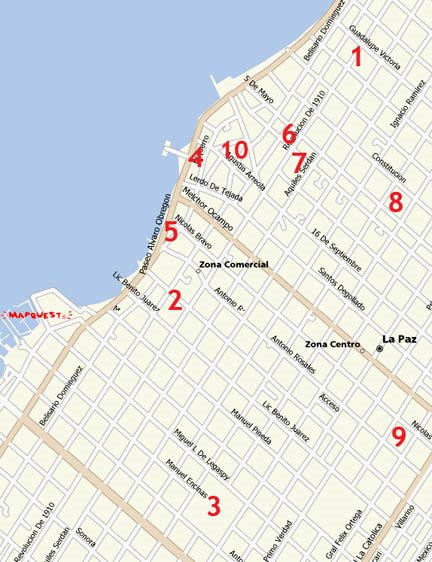
Art galleries are springing up in La Paz like cactus flowers after the rains. In the past year alone, five new galleries have opened, all in easy walk from one another. In addition, there are treasures on the walls of a new restaurant, a bookstore and a coffeeshop. I’ve drawn a map that will lead you on a self-guided tour of 10 venues for art browsing. Each red dot on the map below is numbered, matched up to the key below the map. Most galleries closed for a holiday break; they should be open again by Jan. 5. Your first stop could be the tourist information centre on the corner of 16 de Septiembre and Belizario Dominguez. It’s a few steps away from our first stop on the gallery circuit. There you can pick up a city map and learn more about La Paz.

3. Loto Cafebrería
This little gem of an enterprise is a coffeeshop, gallery, art workshop, gift and book-and-magazine store rolled into one. Loto recently celebrated its first anniversary. It’s on Independencia 415 (between Revolución and Serdán across the street from the cathedral). Phone number is 122-5054. There is generally a new exhibit every month. Hours: 8 a.m. to 10 p.m. Monday through Friday and Saturday 9 a.m. to 10 p.m.
4. Allende Books
This is mainly an English-language bookstore, but you will find lots of art on the shelves and walls at Independencia #518, between Serdan and G. Prieto. Some of what you’ll see: engravings by La Paz artist Rojo, jewelry by La Reyna Sofia, paintings by San Miguel de Allende artist Carmelo Gutierrez, and retablos (bookstore owner Diane describes these as “thank-you notes to Jesus”) by indigenous artists. Winter hours are 10 a.m. to 7 p.m. Monday through Friday and Saturday 10 a.m. to 2 p.m. Phone number is (612)125 9114.
5. Baja Six Art Group Gallery
Check back sometime in the future for this one. Classes continue, but the gallery is dormant. There are no regular hours posted. The building is next door to the art supplies store Papeleria Agruel, Guillermo Prieto #189 (between Reforma and Independencia).
6. Galerías Pax
This bright and shiny gallery is also a gift store and coffeeshop. It opened in December with an exhibit of recent work by La Reyna Sofia. In January, you can see paintings by San Luis Potosi artist Martha Harris. Gallery head Susana Alexander y Santin, who has moved here from Tijuana, also features the work of several high-quality artisanos from mainland Mexico. Location: Guillermo Prieto #1250 (between Cinco de Mayo and Constitución). Phone number is 121-6853. Hours 8 a.m. to 8 p.m. Monday through Friday; also open Saturday.
7. Galería de Arte Tonantzin
The gallery owners were once lawyers in Mexico City, but they developed a passion for art. Last year they moved to La Paz, which, says Moíses, enchanted them immediately. Tonantzin (the name has connections to both the Aztec goddess and the Virgin Mary) is not just an art gallery, but a cultural space for live performances. You'll find prehistoric pieces and contemporary Sudcalifornian and Latin American artists. There are concerts of live music in the gallery courtyard some evenings. Location: Constitución 320 (between Aquiles Serdán and Revolución), the same block as the post office. Phone number: 044-612-154-8136. Hours: 10 a.m. to 2 p.m. and 5 to 8:30 p.m. Monday to Saturday.
8. Las Tres Vírgenes
It’s actually a restaurant, but this stately old mansion-turned-restaurant is also the showcase for paintings of La Paz artist Ken Bonner, whose work is inspired by the beauty and colours of the Baja. You can see Bonner’s paintings whenever the restaurant is open, 5 to about 11 p.m., Tuesday through Sunday (the restaurant is closed Mondays). Las Tres Vírgenes reopened in December at this new location, 1130 Madero (between Constitución and Hidalgo), in the same block but across the street from its old location. For more information, contact the artist at painting_ken@hotmail.com or contact the restaurant (telephone 123-2226 or email lastresvirgenes@email.com ).
9. Ches & Gabo
The gallery features artists Alejandra Morente, Alfredo Mendoza and the well-known Baja painter Gabo. For now, viewing is by appointment only. I’m told that the gallery will soon establish regular hours and that there will also be shows of works by visiting artists. You can check to see if hours are posted on the door as you pass by the gallery on Belizario Dominguez 274 (between Cinco de Mayo and Constitución), Meanwhile, for information you can phone Alfredo on his cell phone: 044-612-157-8244.
10. Galería La Paz
Sidne Byars, an artist, collector and real-estate agent, established her first art gallery in La Paz 13 years ago. She features contemporary Mexican artists such as Gabo and Miguel Ramirez. You will also find original pieces that are functional – a clock, a lazy susan, a piece of furniture. The gallery is on the Malecón on Alvaro Obregón 299 and Constitución. Galería La Paz, which doubles as a real estate office, is open from 10 a.m. to 6 p.m. A second gallery is on Independencia, between Belizario Dominguez and Obregón. For more information, contact Sidne Byars sidne@galeria-la-paz.com
OFF THE MAP
Art galleries are springing up in La Paz like cactus flowers after the rains. In the past year alone, five new galleries have opened, all in easy walk from one another. In addition, there are treasures on the walls of a new restaurant, a bookstore and a coffeeshop. I’ve drawn a map that will lead you on a self-guided tour of 10 venues for art browsing. Each red dot on the map below is numbered, matched up to the key below the map. Most galleries closed for a holiday break; they should be open again by Jan. 5. Your first stop could be the tourist information centre on the corner of 16 de Septiembre and Belizario Dominguez. It’s a few steps away from our first stop on the gallery circuit. There you can pick up a city map and learn more about La Paz.
1. Teatro Juárez
This historic building opened as a community theatre almost 100 years ago. It’s now a centre for music, dance and theatre, as well as exhibitions of art. A group of citizens has undertaken a major restoration project, financed by people who support the theatre. There’s generally a new exhibit every month. Location: Belizario Dominguez between 16 de Septiembre and Independencia. Hours: 9 a.m. to 1:30 p.m. and 5 to 7 p.m. Monday through Friday.
2. Galería Gato Negro
La Paz artists Lila Magallón and Nora White opened this gallery in 2008. Last month they launched a major show, continuing this month, of 10 contemporary La Paz painters and sculptors. The gallery is next to Teatro Juárez on Belizario Domingez 1435, between 16 de Septiembre and Independencia. An artist is on hand 10 am to 2 pm Monday through Saturday, but you can visit the gallery whenever the adjoining restaurant is open (8 a.m. to 11 p.m.). For more information, e-mail galeriagatonegro@gmail.com
This historic building opened as a community theatre almost 100 years ago. It’s now a centre for music, dance and theatre, as well as exhibitions of art. A group of citizens has undertaken a major restoration project, financed by people who support the theatre. There’s generally a new exhibit every month. Location: Belizario Dominguez between 16 de Septiembre and Independencia. Hours: 9 a.m. to 1:30 p.m. and 5 to 7 p.m. Monday through Friday.
2. Galería Gato Negro
La Paz artists Lila Magallón and Nora White opened this gallery in 2008. Last month they launched a major show, continuing this month, of 10 contemporary La Paz painters and sculptors. The gallery is next to Teatro Juárez on Belizario Domingez 1435, between 16 de Septiembre and Independencia. An artist is on hand 10 am to 2 pm Monday through Saturday, but you can visit the gallery whenever the adjoining restaurant is open (8 a.m. to 11 p.m.). For more information, e-mail galeriagatonegro@gmail.com
3. Loto Cafebrería
This little gem of an enterprise is a coffeeshop, gallery, art workshop, gift and book-and-magazine store rolled into one. Loto recently celebrated its first anniversary. It’s on Independencia 415 (between Revolución and Serdán across the street from the cathedral). Phone number is 122-5054. There is generally a new exhibit every month. Hours: 8 a.m. to 10 p.m. Monday through Friday and Saturday 9 a.m. to 10 p.m.
4. Allende Books
This is mainly an English-language bookstore, but you will find lots of art on the shelves and walls at Independencia #518, between Serdan and G. Prieto. Some of what you’ll see: engravings by La Paz artist Rojo, jewelry by La Reyna Sofia, paintings by San Miguel de Allende artist Carmelo Gutierrez, and retablos (bookstore owner Diane describes these as “thank-you notes to Jesus”) by indigenous artists. Winter hours are 10 a.m. to 7 p.m. Monday through Friday and Saturday 10 a.m. to 2 p.m. Phone number is (612)125 9114.
5. Baja Six Art Group Gallery
Check back sometime in the future for this one. Classes continue, but the gallery is dormant. There are no regular hours posted. The building is next door to the art supplies store Papeleria Agruel, Guillermo Prieto #189 (between Reforma and Independencia).
6. Galerías Pax
This bright and shiny gallery is also a gift store and coffeeshop. It opened in December with an exhibit of recent work by La Reyna Sofia. In January, you can see paintings by San Luis Potosi artist Martha Harris. Gallery head Susana Alexander y Santin, who has moved here from Tijuana, also features the work of several high-quality artisanos from mainland Mexico. Location: Guillermo Prieto #1250 (between Cinco de Mayo and Constitución). Phone number is 121-6853. Hours 8 a.m. to 8 p.m. Monday through Friday; also open Saturday.
7. Galería de Arte Tonantzin
The gallery owners were once lawyers in Mexico City, but they developed a passion for art. Last year they moved to La Paz, which, says Moíses, enchanted them immediately. Tonantzin (the name has connections to both the Aztec goddess and the Virgin Mary) is not just an art gallery, but a cultural space for live performances. You'll find prehistoric pieces and contemporary Sudcalifornian and Latin American artists. There are concerts of live music in the gallery courtyard some evenings. Location: Constitución 320 (between Aquiles Serdán and Revolución), the same block as the post office. Phone number: 044-612-154-8136. Hours: 10 a.m. to 2 p.m. and 5 to 8:30 p.m. Monday to Saturday.
8. Las Tres Vírgenes
It’s actually a restaurant, but this stately old mansion-turned-restaurant is also the showcase for paintings of La Paz artist Ken Bonner, whose work is inspired by the beauty and colours of the Baja. You can see Bonner’s paintings whenever the restaurant is open, 5 to about 11 p.m., Tuesday through Sunday (the restaurant is closed Mondays). Las Tres Vírgenes reopened in December at this new location, 1130 Madero (between Constitución and Hidalgo), in the same block but across the street from its old location. For more information, contact the artist at painting_ken@hotmail.com or contact the restaurant (telephone 123-2226 or email lastresvirgenes@email.com ).
9. Ches & Gabo
The gallery features artists Alejandra Morente, Alfredo Mendoza and the well-known Baja painter Gabo. For now, viewing is by appointment only. I’m told that the gallery will soon establish regular hours and that there will also be shows of works by visiting artists. You can check to see if hours are posted on the door as you pass by the gallery on Belizario Dominguez 274 (between Cinco de Mayo and Constitución), Meanwhile, for information you can phone Alfredo on his cell phone: 044-612-157-8244.
10. Galería La Paz
Sidne Byars, an artist, collector and real-estate agent, established her first art gallery in La Paz 13 years ago. She features contemporary Mexican artists such as Gabo and Miguel Ramirez. You will also find original pieces that are functional – a clock, a lazy susan, a piece of furniture. The gallery is on the Malecón on Alvaro Obregón 299 and Constitución. Galería La Paz, which doubles as a real estate office, is open from 10 a.m. to 6 p.m. A second gallery is on Independencia, between Belizario Dominguez and Obregón. For more information, contact Sidne Byars sidne@galeria-la-paz.com
OFF THE MAP
They’re outside this map’s boundaries, but don’t forget these two major venues for art exhibitions in La Paz.
Alianza Francesa: There’s always a new exhibit at the French cultural centre. Admission is free. Centro Cultural Roger de Conynk is on Revolución 635 between Moreles and Guadalupe Victoria. It’s open Monday through Friday 10 a.m. to 1 p.m. and 5 to 7 p.m, and on Saturday 9 a.m. to 2 p.m. It’s the site of films, live performances of music, roundtable discussions and other special events.
Galería de Arte Carlos Olachea: Exhibits change monthly at this major gallery, which is next to Teatro de la Ciudad at Unidad Cultural, Navarro and Héroes de Independencia. Admission is free. Hours are Monday through Friday, 8 a.m. to 6 p.m. and weekends 9 a.m. to 6 p.m. Also check out the vestibule of Teatro de la Ciudad for other changing exhibits.
Alianza Francesa: There’s always a new exhibit at the French cultural centre. Admission is free. Centro Cultural Roger de Conynk is on Revolución 635 between Moreles and Guadalupe Victoria. It’s open Monday through Friday 10 a.m. to 1 p.m. and 5 to 7 p.m, and on Saturday 9 a.m. to 2 p.m. It’s the site of films, live performances of music, roundtable discussions and other special events.
Galería de Arte Carlos Olachea: Exhibits change monthly at this major gallery, which is next to Teatro de la Ciudad at Unidad Cultural, Navarro and Héroes de Independencia. Admission is free. Hours are Monday through Friday, 8 a.m. to 6 p.m. and weekends 9 a.m. to 6 p.m. Also check out the vestibule of Teatro de la Ciudad for other changing exhibits.
30.11.08
ALL THOSE WOMEN IN LA REYNA'S LIFE
La Reyna Sofia surrounds herself with an entourage of unexpected women. Among them you will find women wrestlers and boxers, virgins and prostitutes. They exist as tiny  figures encased in glass, framed in metal, portraits hung from chains and beads. Sofia’s women are miniature works of art. And they have been her obsession these past five years.
“Why women?” I ask.
“I love everything about my women,” says Reyna Sofia Canales Orguayo. “I believe that when I paint a woman – her clothes, her boots, all of the details – I can make her come alive.” Indeed, you can appreciate the attention to detail when you turn over a pendant or earring: each of her women has a back, as well as a front.
Sofia works in pastels, water colours, tempura and ink. The women in her paintings and jewelry are bathed in a rainbow of colour.
 “Lots of colours – to create a sense of happiness,” she says.
The 30-year-old artist and her husband Luis Carlos Rojo came to La Paz from Mazatlán a year ago. Luis Carlos is also an artist, an engraver. They have a two-year-old son.
Sofia smiles when I ask about her calling card and the signature on her work: “La Reyna Sofia.” She says her birth name – which means queen – is perfect for what she does. She needs no other title for her work.
Sofia is part of a blossoming art scene in La Paz. Like many other artists and artisans, she sells her work in sidewalk exhibits and new galleries in the centre of the city. If you are looking for hand-crafted gifts this December, here is a starter list of spots to browse, including the places where you will find work by Sofia and her husband.
Allende Books of La Paz: Independencia 518, between Serdan and G. Prieto, (612)125 9114. This English-language bookstore also sells some hand-crafted items, including Sofia’s necklaces.
Callejón Cultural: Artists and artisans are exhibiting and selling their work Saturdays 10 a.m. to 6 p.m. in December in the pedestrian lane called 21 de Agosto (next to Dorian’s between 16 de Septiembre and Arreola). The event is sponsored by the city of La Paz. You will find work by Sofia and her husband here.
Casa del Artesano Sudcaliforniano: Exhibit and sale of regional arts and crafts in wood, shell, clay, weaving, cultured pearls and more. Open daily 10 a.m. to 10.p.m., Malecón and Bravo next to the skateboard park. Information: 128-8707.
Galería Pax: Guillermo Prieto 1250 (between 5 de Mayo and Consitución), 121-6853. This is a new gallery, gift shop and cafe. An exhibit of Sofia’s work opens here Dec. 12.
Malecón: the area of the kiosk at the foot of 16 de Septiembre is the site of many events where you will find artisans selling their work. For example, the Sudcaliforniano folkloric festival, Dec. 13, features crafts as well as music, dance, stories, poetry and traditional foods, starting at 8 p.m.
 figures encased in glass, framed in metal, portraits hung from chains and beads. Sofia’s women are miniature works of art. And they have been her obsession these past five years.
“Why women?” I ask.
“I love everything about my women,” says Reyna Sofia Canales Orguayo. “I believe that when I paint a woman – her clothes, her boots, all of the details – I can make her come alive.” Indeed, you can appreciate the attention to detail when you turn over a pendant or earring: each of her women has a back, as well as a front.
Sofia works in pastels, water colours, tempura and ink. The women in her paintings and jewelry are bathed in a rainbow of colour.
 “Lots of colours – to create a sense of happiness,” she says.
The 30-year-old artist and her husband Luis Carlos Rojo came to La Paz from Mazatlán a year ago. Luis Carlos is also an artist, an engraver. They have a two-year-old son.
Sofia smiles when I ask about her calling card and the signature on her work: “La Reyna Sofia.” She says her birth name – which means queen – is perfect for what she does. She needs no other title for her work.
Sofia is part of a blossoming art scene in La Paz. Like many other artists and artisans, she sells her work in sidewalk exhibits and new galleries in the centre of the city. If you are looking for hand-crafted gifts this December, here is a starter list of spots to browse, including the places where you will find work by Sofia and her husband.
Allende Books of La Paz: Independencia 518, between Serdan and G. Prieto, (612)125 9114. This English-language bookstore also sells some hand-crafted items, including Sofia’s necklaces.
Callejón Cultural: Artists and artisans are exhibiting and selling their work Saturdays 10 a.m. to 6 p.m. in December in the pedestrian lane called 21 de Agosto (next to Dorian’s between 16 de Septiembre and Arreola). The event is sponsored by the city of La Paz. You will find work by Sofia and her husband here.
Casa del Artesano Sudcaliforniano: Exhibit and sale of regional arts and crafts in wood, shell, clay, weaving, cultured pearls and more. Open daily 10 a.m. to 10.p.m., Malecón and Bravo next to the skateboard park. Information: 128-8707.
Galería Pax: Guillermo Prieto 1250 (between 5 de Mayo and Consitución), 121-6853. This is a new gallery, gift shop and cafe. An exhibit of Sofia’s work opens here Dec. 12.
Malecón: the area of the kiosk at the foot of 16 de Septiembre is the site of many events where you will find artisans selling their work. For example, the Sudcaliforniano folkloric festival, Dec. 13, features crafts as well as music, dance, stories, poetry and traditional foods, starting at 8 p.m.
Where else: If I've missed a spot you think should be in this list, please send me an e-mail with the information we need to find your suggested place to browse. rozinlapaz@yahoo.com
29.9.08
FINDING YOUR NEXT GOOD BOOK
If you’re an English-reading bookworm in La Paz, lucky you. Books are not hard to find. (If I sound envious, that’s because I am writing this from Iquique, Chile, where I have searched in vain to scratch my itch for books in English). Here is a list of places to get books in La Paz, including both English and Spanish-language sources. These will be high-priority stops when I get back in town at the end of October. If I have missed your source of books in La Paz, please send word to rozinlapaz@yahoo.com
Allende Books
The city’s English-language bookstore reopened Oct. 1 after a summer break. Its new location is close to Jardin Velasco and the Cathedral, at Independencia #518, between Serdan and G. Prieto (612)125 9114. This tiny shop, which opened a year ago at its original location on Allende Street, has a little something for everyone. You will find a very nice selection of books on the Baja and mainland Mexico, as well as current fiction and non-fiction imported from the United States. The store features the Moon and Lonely Planet travel guides, maps, some materials for boaters and fishermen (Sea of Cortez Cruiser's Guide, most recent fishing maps of the waters in the Sea of Cortez and Pacific Coast), Spanish language study materials and dictionaries. There's an assortment of children's books, many bi-lingual, books featuring Mexico style interior decoration and desert gardening, not to mention cook books, some by local authors. You will also find many hand-selected gift items from the peninsula, mainland Mexico and Central America. And it's all in English. Open Monday through Friday 10 a.m. to 6 p.m. and Saturdays 10 to 2. Allende Books has a website: Allendebooks.com
Allende Books is also a good place to find out more about the La Paz book group – to learn where, when and what book will be discussed. The book group is slated to resume in November. According to plans made last spring, for November’s meeting the group’s selection is Three Cups of Tea, One Man’s Mission to Promote Peace . . . One School at a Time, by Greg Mortenson and David Oliver Relin. For the December meeting, the selection is Bel Canto, by Ann Patchett.
Librería Educal Libros y Arte
Most reading material is in Spanish, but this government-supported bookstore is a Mexican cultural gem when it comes to gift-buying and browsing. The store opened a year ago at the Antigua Presidencia Municipal de la ciudad de la Paz (Avenida 16 de Septiembre at the corner of Belisario Domínguez, (612) 128 94 21). That’s next door to the tourism office. You will find CDs, children’s toys and art objects, as well as books here. For more information (in Spanish), go to the website at lapaz@educal.com.mx
Libros de Cristal
Formerly Libros Libros (Books Books), Libros de Cristal is on the corner of Constitucion and Madero (Constitucion 195 (612)1221410). In English, you’ll find some magazines, a handful of art and Baja/Mexico travel books – not a lot for the English reader. But the selection in Spanish is excellent: popular fiction, kids’ books, cookbooks, some maps and travel books (not like Moon Guides, Rough Guides or Lonely Planet). The store used to stock paperbacks, but on a recent visit, that rack was gone.
Ramirez:
This large variety store bordering Jardin Velasco (Calle 5 de Mayo 204 (612)1227692) carries everything from chocolates to furniture. Their books section is mainly in Spanish, but you will also find some Baja books in English and a shelf or two of English magazines and mass market paperbacks. Their well-stocked shelves of Spanish-language books includes dictionaries in Spanish/German, Spanish/French, Spanish/Italian, Spanish/Portuguese.
Loto Cafebreria:
Its location is the 400-block of Independencia across from the side entrance of the Cathedral near Jardin Velasco. Loto is a coffee house, patisserie, sandwich shop, Internet café, gathering spot for smart young Mexicans in the evenings, art workshop centre and art gallery all rolled into one. And there is a free book exchange – Spanish, English and a smattering of other languages, too. Here is a sample of English-language publications you might find for sale at Loto. Dwell, Art And Deco, Architectural Digest, Cosmopolitan, Infashion, Southwest Art, B and W, Mac Life. And here are a few book titles you might run across: thrillers of Stephen King, titles such as The street Lawyer, by John Grisham; Black boy, by Richard Wright; The Virgin Blue, by Tracy Chevalier; Amistad, by Alex Pate. Loto celebrates its first anniversary with a fiesta Nov. 3.
Club Cruceros’ free book-exchange:
This book exchange in the Club Cruceros’ clubhouse is a great place to find beach reads, but you will also encounter the occasional Pulitzer-prize winner and classic. The clubhouse has magazines of a certain vintage and a VHS/DVD rental library. While you’re there, consider taking out a membership for $10 (or 100 pesos) per year. Club Cruceros de La Paz is a nonprofit organization dedicated to helping less fortunate children of La Paz and to exchanging cruising information. In addition, club members organize a large variety of social activities. Members are mainly ocean cruisers, but landlubbers are welcome, too. Check out their website at . http://www.clubcruceros.org/ or visit the clubhouse at Marina de La Paz.
If you’re an English-reading bookworm in La Paz, lucky you. Books are not hard to find. (If I sound envious, that’s because I am writing this from Iquique, Chile, where I have searched in vain to scratch my itch for books in English). Here is a list of places to get books in La Paz, including both English and Spanish-language sources. These will be high-priority stops when I get back in town at the end of October. If I have missed your source of books in La Paz, please send word to rozinlapaz@yahoo.com
Allende Books
The city’s English-language bookstore reopened Oct. 1 after a summer break. Its new location is close to Jardin Velasco and the Cathedral, at Independencia #518, between Serdan and G. Prieto (612)125 9114. This tiny shop, which opened a year ago at its original location on Allende Street, has a little something for everyone. You will find a very nice selection of books on the Baja and mainland Mexico, as well as current fiction and non-fiction imported from the United States. The store features the Moon and Lonely Planet travel guides, maps, some materials for boaters and fishermen (Sea of Cortez Cruiser's Guide, most recent fishing maps of the waters in the Sea of Cortez and Pacific Coast), Spanish language study materials and dictionaries. There's an assortment of children's books, many bi-lingual, books featuring Mexico style interior decoration and desert gardening, not to mention cook books, some by local authors. You will also find many hand-selected gift items from the peninsula, mainland Mexico and Central America. And it's all in English. Open Monday through Friday 10 a.m. to 6 p.m. and Saturdays 10 to 2. Allende Books has a website: Allendebooks.com
Allende Books is also a good place to find out more about the La Paz book group – to learn where, when and what book will be discussed. The book group is slated to resume in November. According to plans made last spring, for November’s meeting the group’s selection is Three Cups of Tea, One Man’s Mission to Promote Peace . . . One School at a Time, by Greg Mortenson and David Oliver Relin. For the December meeting, the selection is Bel Canto, by Ann Patchett.
Librería Educal Libros y Arte
Most reading material is in Spanish, but this government-supported bookstore is a Mexican cultural gem when it comes to gift-buying and browsing. The store opened a year ago at the Antigua Presidencia Municipal de la ciudad de la Paz (Avenida 16 de Septiembre at the corner of Belisario Domínguez, (612) 128 94 21). That’s next door to the tourism office. You will find CDs, children’s toys and art objects, as well as books here. For more information (in Spanish), go to the website at lapaz@educal.com.mx
Libros de Cristal
Formerly Libros Libros (Books Books), Libros de Cristal is on the corner of Constitucion and Madero (Constitucion 195 (612)1221410). In English, you’ll find some magazines, a handful of art and Baja/Mexico travel books – not a lot for the English reader. But the selection in Spanish is excellent: popular fiction, kids’ books, cookbooks, some maps and travel books (not like Moon Guides, Rough Guides or Lonely Planet). The store used to stock paperbacks, but on a recent visit, that rack was gone.
Ramirez:
This large variety store bordering Jardin Velasco (Calle 5 de Mayo 204 (612)1227692) carries everything from chocolates to furniture. Their books section is mainly in Spanish, but you will also find some Baja books in English and a shelf or two of English magazines and mass market paperbacks. Their well-stocked shelves of Spanish-language books includes dictionaries in Spanish/German, Spanish/French, Spanish/Italian, Spanish/Portuguese.
Loto Cafebreria:
Its location is the 400-block of Independencia across from the side entrance of the Cathedral near Jardin Velasco. Loto is a coffee house, patisserie, sandwich shop, Internet café, gathering spot for smart young Mexicans in the evenings, art workshop centre and art gallery all rolled into one. And there is a free book exchange – Spanish, English and a smattering of other languages, too. Here is a sample of English-language publications you might find for sale at Loto. Dwell, Art And Deco, Architectural Digest, Cosmopolitan, Infashion, Southwest Art, B and W, Mac Life. And here are a few book titles you might run across: thrillers of Stephen King, titles such as The street Lawyer, by John Grisham; Black boy, by Richard Wright; The Virgin Blue, by Tracy Chevalier; Amistad, by Alex Pate. Loto celebrates its first anniversary with a fiesta Nov. 3.
Club Cruceros’ free book-exchange:
This book exchange in the Club Cruceros’ clubhouse is a great place to find beach reads, but you will also encounter the occasional Pulitzer-prize winner and classic. The clubhouse has magazines of a certain vintage and a VHS/DVD rental library. While you’re there, consider taking out a membership for $10 (or 100 pesos) per year. Club Cruceros de La Paz is a nonprofit organization dedicated to helping less fortunate children of La Paz and to exchanging cruising information. In addition, club members organize a large variety of social activities. Members are mainly ocean cruisers, but landlubbers are welcome, too. Check out their website at . http://www.clubcruceros.org/ or visit the clubhouse at Marina de La Paz.
1.6.08

MAN BEHIND THE COUNTER
The wrought-iron signpost says Escritorio Público – Public Writing Desk. It stands in the small plaza Ignacio Cabezud across from the tourist dock in La Paz. Behind the sign, a weather-beaten stall is open for business. There’s a manual typewriter on the counter, along with pen, paper cutter and stapler. Inside, a photocopying machine pushes up against shelves that bulge with papers.
The man at the counter is Rogelio Askins Aguilar – accountant, bookkeeper and public writer. He has worked in this neighborhood for more than 30 years.
The job of public writer in Latin America is as old as the need to write a letter. Escritores públicos flourished in the days when many people were illiterate. You would find a public writing desk in the central plaza of town, at a table with ink, paper and a sign – maybe a drawing of a quill and scroll for clients who couldn’t read. The writer’s customers sought help with all kinds of paperwork: a note of apology for late payment of fees, an entreaty to an ex-wife to come home, forms to start a business, a letter to a brother gone searching for work.
There aren’t many public writing desks left like the one in the small plaza of La Paz. In an interview, I ask Rogelio about this (our conversation is in Spanish, which I have translated and summarized). Rogelio says his escritorio público could be among the last of its kind in the city. “I had a friend in another neighbourhood, but I don’t think his office is open anymore.”
Drawing on his skills as an accountant and bookkeeper, Rogelio is much more than a public writer. He helps clients with the paperwork of officialdom. This includes tax declarations, health records, immigration documents, agriculture forms, business dealings and the like. That’s the nitty gritty of his day. But after cataloguing the details of the job, he describes what he does in another way: “I do not permit the exploitation of one man by another.”
Rogelio’s office seems out of character in this gentrified plaza. On one side of his shed is the artist Wyland’s mural of wildlife in the Sea of Cortez (Mar del Cortés) . On the other side is a sales office for luxury condos. There are sculptures of sea turtles and a whimsical trio of musicians, seashells brought to life. If you take a closer look at Rogelio’s old wooden shed, you will see it is decorated with fish and figures akin to Baja’s cave paintings. He says he painted them himself, inspired by Wyland.
There is no computer in the escritorio. Rogelio has one at home, but says that here, a typewriter is more valuable. As he points out, it’s tough to use a computer to type in a missing number on a government form.
Rogelio is an old newspaper man. From somewhere beneath the counter he retrieves a pocket-sized brass plate – his press pass. He digs through piles of newsprint on the shelves behind him and emerges with a 25-year-old editorial page from the Mexico City newspaper Despertar de America (To awaken America). He is listed on the masthead as editor-in-chief.
I ask how Rogelio how old he is and get the answer, “Cinquenta” (fifty). He looks at least seventy, and my skepticism shows. He chuckles, then on a notepad he writes “50,” draws an X through it and laughs again. “Sin cuenta,” he says. Ah, a play on words. Sin means without. Cuenta means calculation or account. “¡No tengo (I don’t have) cuenta!”
And then he switches languages, using English for the first and only time during our conversation. As a former news man, he may be worried that I’ll get it wrong. “Seventy-three,” he says. “I am 73.”
Rogelio chuckles again when I ask if people still come to him for help in writing love letters. “Not so much anymore,” he says. However, he is ready for anyone who does arrive with that kind of request. “Ponemos picoretes al papel.” He smiles as he says this. I have trouble getting a definitive translation, despite asking several Spanish speakers. The best I can do: “We put little kisses –little nibbles? – to paper.”
Rogelio tells me he loves everything about his work. “I am my own boss. It’s very entertaining. Each of the people who arrives here comes with a different matter, and it must be resolved. So it’s never boring.”
When the plaza in which Rogelio works was renovated, other street stalls disappeared, making way for art work and concerts. But the government permitted Rogelio to stay, he says – “because this is a service to the community.”
1.3.08
INTERVIEW WITH THE SANDMAN
 Creations as changeable as life, itself
His studio is the city beach of La Paz. He is an artist whose work disintegrates in weeks, to reemerge in another form. And so December’s nativity scene breaks down, becomes February’s pod of whales. This is art that ebbs and flows like the neighbouring tide.
Juan Guillermo Corvera Alemán likes his creations short-lived. That’s why he makes sculptures in sand. “Because it is like life, itself,” he tells me. “It’s of the earth, natural. I do not need to point to something on the wall and say, ‘This is my work.’ ”
Juan’s path to La Paz has been a journey of unforeseen twists. Born in Mexico City, the 28-year-old earned a degree in law. He was halfway through a second degree, this time anthropology, when he decided life wasn’t going the way he wanted. That led to five years of travelling around Mexico.
He was walking down the Malecón in Puerto Vallarta when he saw the sand sculptures of José Gonzales. Juan had no background in art. But he persuaded the sculptor to take him on as a student. Puerto Vallarta is also where Juan met his partner Alma, 26. She’s trained as an architect.
Since then, the two have travelled together. Juan creates sand sculptures, Alma makes jewelry. They live on the contents of donation boxes for Juan’s sculptures and from the sale of Alma’s jewelry and handicrafts.
Is it enough to cover living expenses? “Some days yes, some days no,” Juan says. I pass by every few days to watch his progress and to talk. Our conversation is in Spanish, which I’ve translated and summarized.
Today Juan gives me a tour. He is finishing a pyramid of figures wrapped around one another, arms stretched upwards, individual features obscured. It’s called Almas (Souls), the same as his partner’s name.
Then there is La Cara (the face) with its gaping mouth. Is the expression fear? Amazement? Death?
Nearby, a cluster of men and women hug one another, their faces dreamy, peaceful. Juan calls this Union de los Pueblos por Medio del Fuego y la Medicina (Villages united by fire and medicine). He says if you look closely, you can see the seven parts of the peyote plant.
And here is a humongous hand, index finger pointing up. Like many of the other pieces, this sculpture reaches skyward. Are most of your themes spiritual, I ask? Is the finger pointing toward God? Not exactly, he says. It’s pointing to “la grandeza” (grandness or magnificance). Yes, the themes are spiritual, but he shies away from the label of God.
Juan and Alma arrived in La Paz a few months ago. Donations are not as generous here as on the mainland, but Juan says it’s peaceful and people are good. They decided this would be the place for Alma to have their first baby, due near the end of February.
A child will change life for you, I say. And you will need more money. The work of a lawyer or architect is more secure, more lucrative. Maybe that wouldn’t be so bad? Juan clutches his throat. “Esclavos,” I think he says. Esclavo means "slave."
So he’ll continue his work as a sculptor of sand? “Ojalá (god willing),” he says. The plan is to work their way up the Baja peninsula as soon as Alma and the baby can travel. Juan’s idea is to “sell” sand sculptures to businesses along the way. He will try to interest hotels in hiring him to create pieces on a particular theme to promote events and festivals – sand sculptures for a tour of bikers, for example.
Juan has created a sand version of La Pieta. He has given the Virgin Mary a Mexican face. In fact, she looks a lot like his partner Alma. The sculptor says he chose La Pieta because he admires Michelangelo’s work. And because he is hoping that the Catholic passersby will be moved to be a little more generous with their donations.
This week Juan finished his latest sculpture: It's a moon, a baby, and a large sheltering hand. The creation honours his new baby daughter, born around the time of the February full moon. Her name is Luna.

20.2.08
ALIEN LAND, COMMON DESTINY

 The exhibit Tierra Ajena, work by “Gabo” Gabriel Rodríguez, runs until March 16 at Galería de Arte Carlos Olachea, Navarro and Héroes de Independencia, next to Teatro de la Ciudad. The opening is Feb. 22, 8 p.m.
GABO IN A FOREIGN LAND
The artist “Gabo” Gabriel Rodríguez calls his new exhibit of paintings Tierra Ajena –Someone Else’s Land. As I learn in an interview with Gabo, that expression carries a basketful of reflections: everyday life defined as alien territory, a loner’s sense of humor, two castles and the heroism of a grandfather. Let’s begin with the grandfather.
FOREIGN LAND, COMMON DESTINY
Don José Guadalupe Romo Romo, Gabo’s maternal grandfather, lived in a village in the state of Aguascalientes in western central Mexico. The name of the village: Tierra Ajena.
FOREIGN LAND, COMMON DESTINY
Don José Guadalupe Romo Romo, Gabo’s maternal grandfather, lived in a village in the state of Aguascalientes in western central Mexico. The name of the village: Tierra Ajena.
It was during the Cristero War of 1926-1929, the armed uprising against the anti-Catholic Mexican government. Don José was giving protection to the Cristeros, and he allowed his house to be used for religious services.
One day, Gabo says, a traitor alerted federal troops. Don José did what he could to enable the parishioners to escape, then waited for the troops to arrive. A speedy trial ended in a sentence of hanging.
But in that rocky village on the plains, it took a long time to find a tree for the execution. On the first attempt, the hangman’s knot unraveled, sending the condemned man crashing to the ground. He got up and shook off the dirt. “Don’t be idiots,” he is reported to have said, before tying the knot himself and surrendering to his fate.
WHAT DOES 'TIERRA AJENA' HAVE TO DO WITH THIS EXHIBIT?
The story of his grandfather is a source of pride for Gabo and part of his own identity. Don José had come from Europe to this foreign land -- to a place actually named “someone else’s land.” Because of the war, Gabo’s mother was forced to move away; she, too, grew up in “someone else’s land.” Gabo feels that he, himself, lives in a place that is not his own.
WHAT DOES 'TIERRA AJENA' HAVE TO DO WITH THIS EXHIBIT?
The story of his grandfather is a source of pride for Gabo and part of his own identity. Don José had come from Europe to this foreign land -- to a place actually named “someone else’s land.” Because of the war, Gabo’s mother was forced to move away; she, too, grew up in “someone else’s land.” Gabo feels that he, himself, lives in a place that is not his own.
More than that, Gabo believes all of us live in someone else’s land. We are children of people who come from somewhere else. We are guardians of a world belonging to future generations. And we dream, he says, about becoming better people in our adopted home. Maybe that's why the exhibit bears the subtitle: Destino Común (common destiny).
Now Gabo tells me that – for all he has just said – there is, in fact, no direct relationship between tierra ajena and the exhibit. He means the title to be simply an invitation to reflect on the meaning of living in someone else’s land.
PEOPLE WHO HAVE ALREADY EATEN
PEOPLE WHO HAVE ALREADY EATEN
I ask Gabo what he would like people to know about this exhibit.
“Absolutely nothing.”
His art is not in the tradition of Diego Rivera, José Clemente Orozco and David Alfaro Siqueiros, Mexican muralists whose work carries social and political messages.
“No, a picture is a pleasure,” he says. “A picture is a digestive – a drink for after dinner. If there is no meal, you don’t want art. A picture is for people who have already eaten.”
Gabo’s paintings have been compared to those of Marc Chagall. They’ve also been described as “garish and thought-provoking, bizarre images from a fertile mind.”
In this exhibit, you may be reminded of Baja California’s famous pinturas rupestres, the prehistoric cave murals of human figures, four-legged animals, birds and arrows. “Even the creators of the pinturas rupestres came from elsewhere,” Gabo notes.
The artist is an animated talker. He widens his eyes, waves his hands, bobs and weaves in his seat. In conversation, he paints pictures with his body language. He is enjoying himself. In person and in his art, Gabo has a sense of humour.
There are artists whose work is cerebral, Gabo says, whose paintings concern themselves with rot, carnivores, enormous tongues. Here Gabo’s eyes bulge, his voice drops an octave. The playfulness is edged with sarcasm.
He has a problem with that artistic personality. “You want to take a picture home, hang it on your wall. You want something happy, something amusing. You’re not going to pay to be depressed. You are going to pay for pleasure. You say, ‘Why bring more problems into my house? I already have lots of those.’”
ALMOST LIKE GOD
Gabo is successful. Work in his gallery in Todos Santos commands a high price. He is not alone. In fact, he says, the art scene in Baja California Sur is exceptionally good, especially in Todos Santos, San José del Cabo and Loreto. He describes it as “a phenomenon” – thirty artists selling 1,500 paintings each year.
ALMOST LIKE GOD
Gabo is successful. Work in his gallery in Todos Santos commands a high price. He is not alone. In fact, he says, the art scene in Baja California Sur is exceptionally good, especially in Todos Santos, San José del Cabo and Loreto. He describes it as “a phenomenon” – thirty artists selling 1,500 paintings each year.
In the community of Todos Santos, home to many artists from the U.S., Gabo is a loner. The atmosphere is not all that convivial, he acknowledges. “It doesn’t surprise me because our countries have very different roots and cultures,” he says. “North Americans may not get along well with the Mexicans, we may not eat at the same table. But together, we are a phenomenon.”
In any case, he says, creating art is a solitary act for him: The true artist must produce art in the same way one goes to the bathroom. You have to be alone.
He tells me art is a sacred niche for him, where he can develop spiritually. It’s a quest for truth. “It is a language of feeling with colours and with forms that are feelings. And the success depends on the honesty with which one paints.”
An artist is a creator of spaces. He says he feels almost like God when he succeeds in his creations.
WHAT IS IT WITH GABO AND HIS CASTLES?
WHAT IS IT WITH GABO AND HIS CASTLES?
There is a flamboyance to Gabo. He signs his work GABO. He doesn’t use his full name. That’s because he grew up with so many other Gabriels: his father, his sister Gabriela and three more Gabriels in the family next door. His mother called him Gabo; the name became his artistic signature.
We are in the artist’s new studio in La Paz, where he has lived for most of the last 30 years. “Many people think you live in Todos Santos,” I say.
“In Todos Santos, they think I live in La Paz. In La Paz, they think I live in Todos Santos.”
I look up at the sky-high, convoluted ceiling. From the hills above La Paz, the turquoise peaks of this new studio are as easy to spot as the twin spires of the cathedral in the city’s main square. His gallery in Todos Santos has been compared to a castle and a Spanish mission. Some call it the “Church of Gabo.”
What is it with Gabo and his castles?
“I paint stars, I paint moons, I paint enormous spaces.” The earth, itself, is on a journey, he says, as it travels in the Milky Way. “The possibilities are very large. And so I always, in my own construction, want to reach toward the sky.”
After an hour with Gabo, I feel as if I, too, have been on a journey of twists and turns. The artist says his work bears no message, but asks us to reflect on the meaning of life as alien territory. He says his pictures are meant to amuse, but describes the act of painting as a spiritual quest for truth. He even says he converses with stones – at least, with the stones that became part of his studio in Todos Santos.
“I talked with the stones,” Gabo tells me, “and I asked them, ‘What do you want?’ And they said, ‘One day, we would like to know the heights.’ Because the stones never knew what it was like to be high up.”
And so, Gabo raised up his stones to be a little closer to the sky.
31.1.08

Queen Julia I at 2007 coronation and talking with me as her reign ends
Julia María Santa Ana Cervantes remembers the day she decided to become Queen of Carnavel. She was a chiquita aged five or six when her parents brought the family down to the Malecón to watch the carros alegóricos, the parade floats that are at the heart the festival. The little girl saw the queen, and she was hooked.
“Her dress had so many jewels, and colours, and a long cape, and feathers. And she wore such a big crown," the 20-year-old said as we talked during the final week of her reign as queen of Carnaval 2007. “It became my fondest dream to have a dress like that.”
In the race for the Carnaval crown, the candidate who brings in the most money wins. Julia raised $186,000 pesos in her 2007 bid and became Queen Julia I. A Carnaval queen doesn’t get prizes, but keeps her gowns. Indirectly, Julia paid for her own royal robes, since the money she raised went towards Carnaval’s bills for costumes and entertainment.
The custom-made coronation gown– she doesn’t give a price tag, just that it’s muy elevado (very high) – “is worth the pain,” she says. All of the clothes for the royal court are hand-stitched by dressmaker Lupita Cosio and her family.
Julia is a little sad that her year as queen is ending, but says she’s glad to know the younger girls in this year’s contest are continuing what she considers a valued tradition.
I ask to take her photo and Julia, obliging like the royalty she is, goes to the car to fetch her crown and sash. As for the dress, it’s at home. She says she may donate it to a museum. Or, she may keep it, a reminder of the childhood dream she made real.
23.12.07
THE OLD MAN AND HIS CREATOR
 The old man looks out into the bay of La Paz. He is an amalgam of childish and old – leathery skin, big ears, a Spencer Tracy face. But he’s dressed in the sailor suit of a young boy. His hat is a folded-paper boat. And around his waist, improbably, he wears a second, jumbo-sized, paper boat. But what really pulls at me are the old man’s smile and the eyes. There is a story behind that face.
El Viejo. . .y el Mar? (The old Man. . .and the Sea?), is one of the most photographed sculptures on the Malecón, La Paz’s seaside promenade. The work’s creator is Guillermo Gómez Macías, an award-winning artist who also sculpted Caracoles Músicos (Seashell Musicians), a recent addition to the small plaza across from the main tourist dock.
I reached Gómez in Guadalajara, where he lives, and asked him about the old man. Here is the story, which I have translated and summarized.
“The sculpture has its origin in the story of a real person – a fisherman from the town of Bucerias in Nayarit. Don José had a small boat, a true work of art made from the trunk of a large tree. On more than one occasion, I offered to buy the boat, but he never wanted to sell it. He was very proud of his possession.
“During one trip to Bucerias, I was surprised to see the boat missing from its usual spot. Don José told me that it had been stolen. I told him how sorry I was. But he said that whoever had stolen the boat must have really appreciated its value. He said his own relationship with the boat had come to an end, and that he hoped whoever had it would treat it with the dignity it deserved.
“What surprised me was that he wasn’t saddened by his loss. Although he had been very fond of his boat and it had, in fact, become part of his identity, what really mattered were his work and his relationship with the sea. The significance of this story is that it makes me think that the means to achieving our goals, while important, are often perishable. Even though we enjoy them and use them while we can, we must not lose sight of the true purpose of our mission.”
I asked Gómez about the title of his sculpture: The Old Man . . .and the Sea?”: the apparent reference to Hemingway’s story of the fisherman Santiago and the sculptor’s use of a question mark.
“Certainly there’s a relationship with Hemingway’s work – the attributes of the characters and the nature of such a basic activity, but one that demands so much strength of character. The question mark is because, deep down, the piece is an allegory to hope.”
At the base of the sculpture there is a poem. It is written by Gómez:
I have a paper boat
It’s made from a page
On which I have written my dreams
It has neither anchors, nor mooring ropes
I want to sail in it
On the seven seas; in the eighth
Where I know I will run aground in the port of my desires
... Has someone ever seen the light shining from his lighthouse?
Guillermo Gómez Macías, 48, was born in Jalisco, the second of nine children in a traditional Mexican family. A show of his latest work opens Jan. 2 in Puerto Vallarta at Galleria Dante, where his art is on permanent exhbit.
If you cannot see the events calendar, go to home page: http://rozinlapaz.blogspot.com/. And if you like this site, please e-mail the link to your friends.
9.12.07
 GETTING TO KNOW LA PAZ
Saturday night in La Paz. It’s a half-block walk downhill from my apartment on Calle Bravo to the skateboard park, tonight the site of an arts and crafts fair. Weave through carvings, jewelry, embroidery, pottery – and stare into the muzzle of a full-sized horse sculpted from metal and coconut palm.
Stroll north along the seaside promenade called the Malecón. In a small plaza across from the dock, the university concert has begun. A small boy dances, dangling tiptoe from his father’s grasp, to a duet of classical guitars.
Walk a few blocks farther. Rock music full-throttles from the bandstand. Teenaged girls jangle money cans for charity. Cars cruise along the seaside street of Obregon.
Now head uphill to the cathedral square for a game of Mexican bingo. The plaza swarms with Lotería players, listening for the call of ¡Bruja! (witch), ¡La Luna! (moon), whatever picture will make their card a winner.
Back along the Malecón. From the discos, waves of high volume wash up against each other; baby-boomer rock crashes into Norteño music. A block more and I’m home. At the corner, a flower seller makes me a gift of one white rose.
The beauty of being an English-speaking newcomer in La Paz is that everything is fresh. The challenge is that there is so much to learn. And that’s the purpose of this website: to list coming events and to share what I discover about music, art and life in the city. Keep me posted on what you know. Tell me what you want to see here. Join me in the fun of getting to know La Paz.
If you cannot see the events calendar, go to home page: http://rozinlapaz.blogspot.com/. And if you like this site, please e-mail the link to your friends.
To reach me, email rozinlapaz@yahoo.com
Subscribe to:
Posts (Atom)